Buying a palletising robot is not choosing a robot; it is redesigning the end of the line. Are bags coming down the line, or cases? How many patterns? Where does the pallet come in, and who takes it away? The answers decide the robot, not the other way round. Here they are, in the order we asked ourselves on the packaging and palletising automation we built for a food line:
One cell, five questions
01 / 05
Payload
The catalogue capacity is product plus gripper. A 25 kg bag gets a 10-15 kg gripper on top, and more under acceleration.
02 / 05
Reach
The farthest corner, the top layer. The layout is built in 3D; no robot is chosen until the worst case has been tested.
03 / 05
Cycle
Pick, carry, rotate, place, return, plus the camera check: that total is what has to meet the line’s takt.
04 / 05
Safety
A forklift drives in, an operator changes the film. Every entry is a scenario: light curtain, door interlock, area scanner.
05 / 05
Pattern
No service call for a new pattern; the operator defines the number of layers, the arrangement and the slip sheet on the HMI.
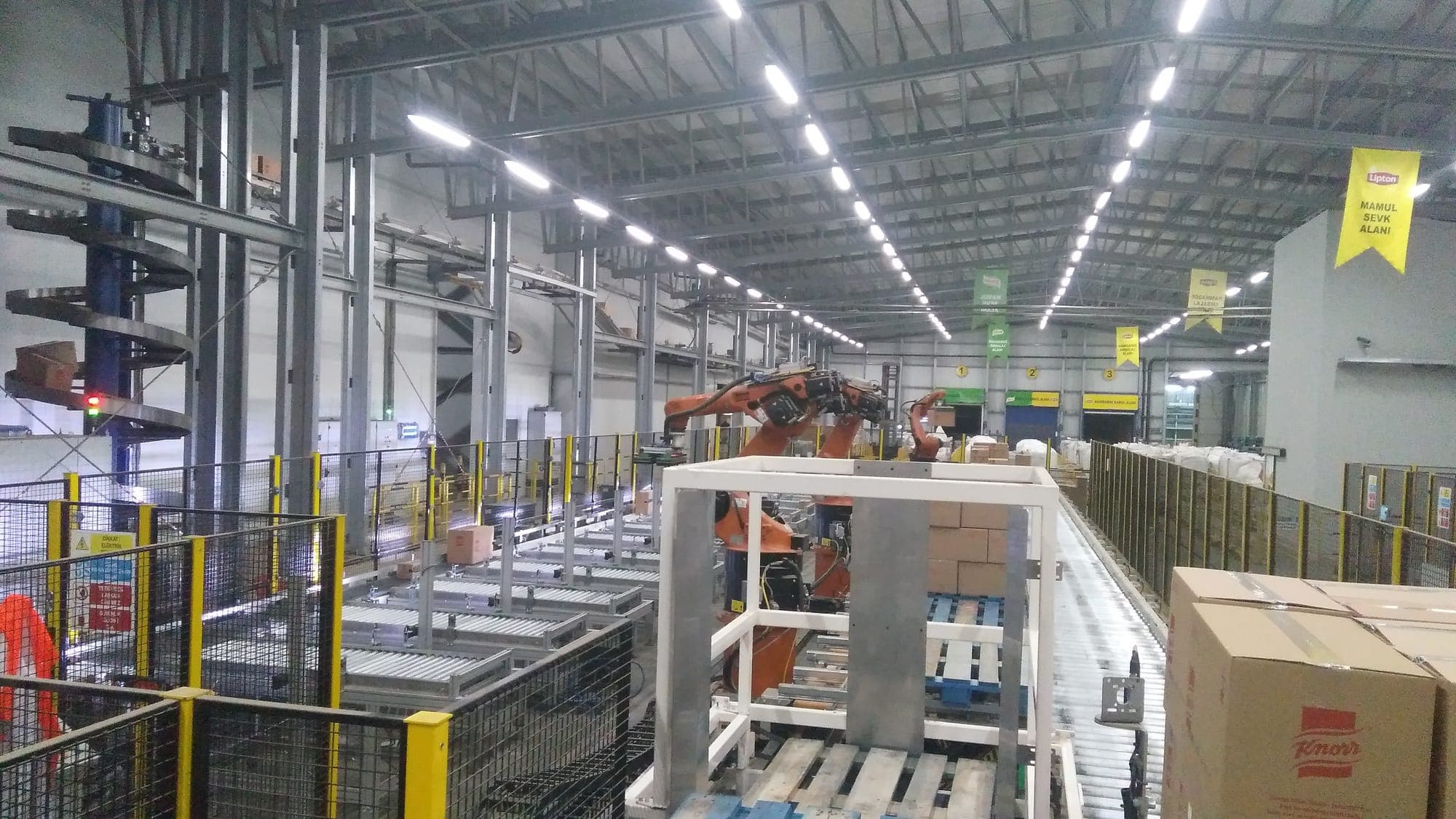
1. How heavy is the product really, gripper included?
The payload in the catalogue covers the product plus the gripper. Don’t buy a 25 kg robot for a 25 kg bag. A vacuum or fork-type gripper easily adds 10-15 kg, and under dynamic load (acceleration) that grows further. When we calculate payload, we decide after designing the gripper, not before.
2. Can it reach the farthest corner of the pallet?
Reach is measured from the robot’s base, not from the tip of the gripper. A double pallet station, high stacking (five or six layers) and the slip sheet laid on the pallet all eat into it. We don’t choose a robot until we have built the layout in 3D and tested the worst case: the farthest corner, the top layer.
3. Does the cycle time meet the line’s takt, or only the robot’s speed?
A robot’s “2 metres per second” tells you nothing. Picking the bag, carrying it, rotating it to the pattern, placing it, coming back: it all adds up. On the food line there was a machine vision check as well: every pack passes the camera, and one with a faulty print never even gets onto the line. That check’s time counts towards the takt too.
4. How will the product and the gripper get along?
Bags and cases need different grippers; with bags, vacuum is often not enough and a fork-type gripper is needed. If the product inside the bag shifts (tea, flour, granules), the gripper has to tolerate it. The design item we spent the most time on was not the robot but the gripper. The robot is standard; the gripper is as specific as your product.
5. Who will cross the safety zone, and how?
A forklift will come in to take the pallet. An operator will change the film roll. Every entry is a safety scenario: light curtain, door interlock, area scanner, or a combination of them. Thinking about this at installation costs a third of what it costs after installation. With the new EU Machinery Regulation coming into force in 2027, the documentation requirement gets stricter still; we cover that in a separate post.
6. Who will program it when the pattern changes?
If you have to call out service for a new pallet pattern, you have bought dependency, not automation. We built the patterns to be defined on the HMI: number of layers, arrangement, slip sheet. The operator defines a new pattern on their own. It became the least visible but most used piece of software in the project.
7. What will the line do when the robot stops?
Breakdowns, maintenance, waiting for pallets. Don’t install without planning a bypass (a manual palletising point) so the line can keep running for a while without the robot. The robot also needs to report its own status to the higher-level system: why it stopped, when it stopped. A month later, that data becomes your most valuable maintenance input.
Once these seven questions are answered, the robot brand and model usually reveal themselves. That is why “which robot?” is our last question.