On a timber line, the real money is not in the block from the middle of the log; it is at the edges. The saw splits the log vertically: a full-length block in the middle and, on either side, a bark-edged side slab with a trapezoidal cross-section. The block goes straight to slicing; no intelligence needed there. The side slab is another story: one edge flat, the other sloping bark. Someone has to decide how many boards come out of it.
For years the operator made that call by eye. An experienced operator makes good calls, but in the ninth hour of a ten-hour shift nobody does. And nobody records the call they made.
- sensors, one pass
- 0sensors, one pass
- recipe sizes, 80-160 mm
- 0recipe sizes, 80-160 mm
- pusher cylinders
- 0pusher cylinders
Laying the slab flat and passing it sideways
The first design decision was mechanical: we laid the side slab flat and turned the line, so the slab passes sideways beneath the sensors. That way the 20 sensors we lined up along its length capture the slab’s bark profile in a single pass. Where the flat face is, where the sloping bark begins: a map accurate to the millimetre.
The algorithm’s one rule
The order recipe lists the board sizes: 80, 90, 100, 110, 120 and 160 millimetres. The algorithm reads the map, places the largest single board that fits and fills the remaining space with the other sizes. The rule is strict: if a 160 fits, it never cuts two 80s. It sounds simple, but the “why” behind the rule is economic: a wide board is worth more than two narrow ones, and every extra cut means one more kerf of waste.
A small confession: in the first version, the algorithm maximised “total area used”. Mathematically right, commercially wrong. After talking to the operators we added recipe priority and the big-board rule. Three days of watching on the shop floor taught us as much as a month of code.
From log to board
01 / 04
Log
The saw splits the log vertically: a block in the middle, a bark-edged side slab on either side. The block goes to slicing; the side slab needs a decision.
02 / 04
Side slab
The side slab is laid flat and passes sideways beneath the sensors.
03 / 04
20 sensors
The 20 sensors lined up along its length capture the bark profile in a single pass, to the millimetre.
04 / 04
Biggest board first
The algorithm places the largest single board that fits and fills the rest with the other sizes. If a 160 fits, it never cuts two 80s.
The pattern is locked; now the slab has to match it
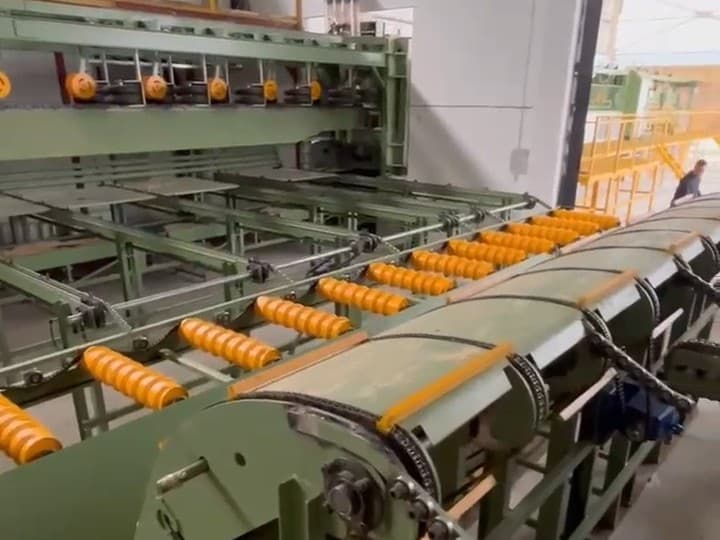
Knowing the cutting pattern is not enough; the slab has to be exactly in position relative to the blades. Receiving cylinders take the slab; as soon as the scan finishes, four pushers rise and push it sideways to the alignment line, and if it overshoots, the receiving cylinders bring it back into position. The blades lock to the pattern and the slab passes through. We designed and built this alignment unit too; knowing it would be the most maintenance-hungry part of the line, we placed the pneumatics and sensors where they are easy to reach.
A cut with no record is a cut that never happened
Every cut goes into the archive: width, length, angle, species, yield. The operator sees the live pattern and the yield recommendation on the HMI; management follows weekly yield by species from the analytics app in the office. We are not sharing the yield figures here, but we can say this much: the moment you start seeing the number, the number starts improving.
If you run a similar line, our first questions will be about your log diameter distribution and your recipe sizes. What the algorithm returns depends on those two tables; we simulate with your data, not with guesses.