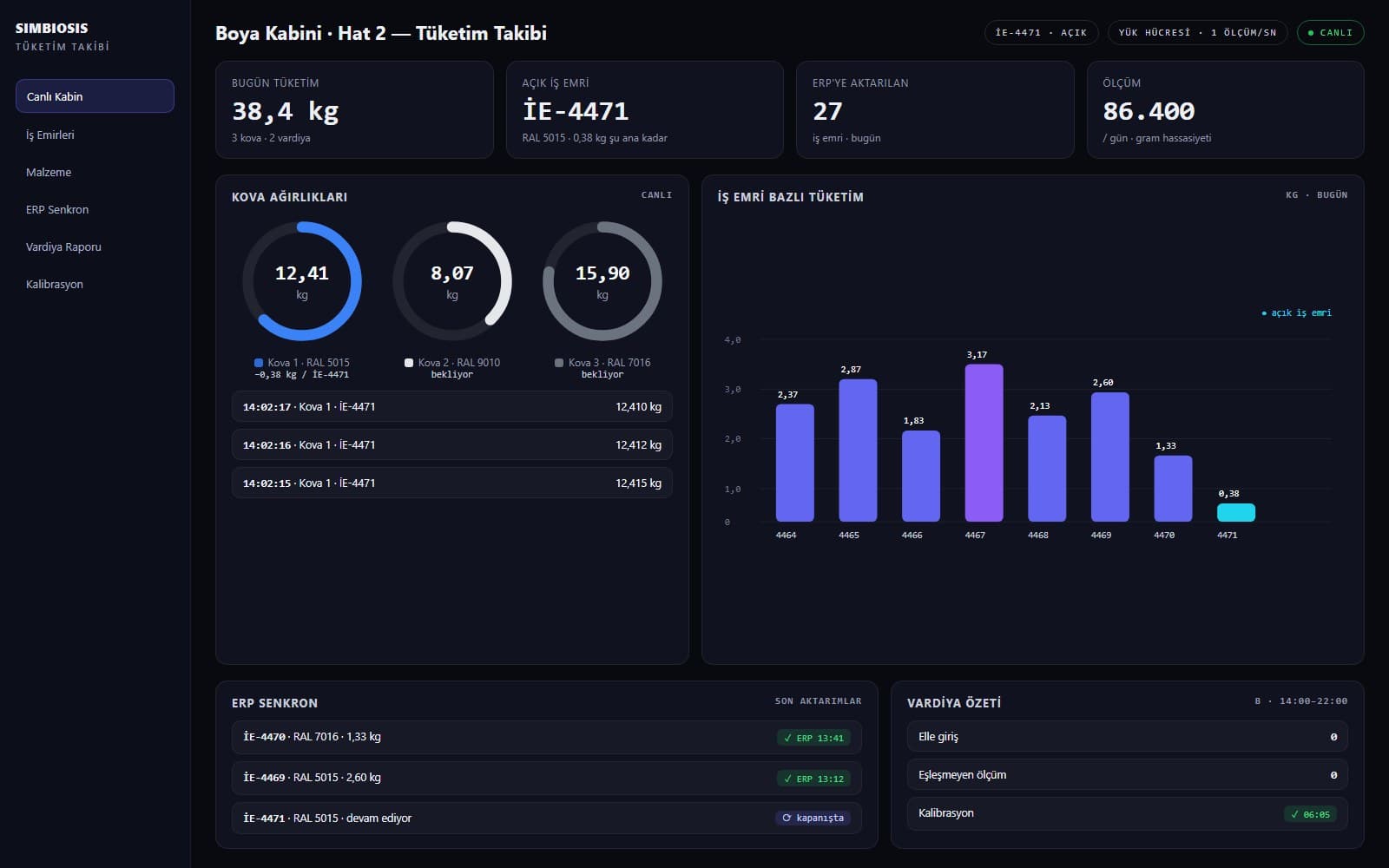
Ask how much paint a booth uses and the answer usually starts with “about”. It is worked back from the supplier’s invoice, corrected by the month-end stock count, and the rest is guesswork. An estimate still produces a cost on paper, but nobody knows how much paint any given work order actually consumed. That was exactly the problem our customer, a valve manufacturer, had: a cost, but no traceability.
If you want to measure, measure mass, not flow
The first thing that comes to mind is a flow meter. For paint, it is a bad idea: viscosity changes, air bubbles get counted, paint left in the hose goes unaccounted for. We put load cells under the buckets instead. Bucket weight is read once a second; the decrease is the consumption. That is 86,400 measurements a day, accurate to the gram. And most importantly, each measurement is matched to the work order open in the booth at that moment.
The matching is the IT side of the job, not the OT side. The operator opens the work order in the booth and starts painting; from then until the work order is closed, every gram is written to it. Pause and switch to another order, and the consumption switches with it. No manual entry, no Excel, no estimates.
- measurements, every day
- 0,400measurements, every day
- measurement, every second
- 0measurement, every second
- manual entries
- 0manual entries
From bucket to ERP
01 / 04
Bucket and load cell
Load cells under the buckets instead of a flow meter: viscosity, bubbles and paint left in the hose cannot skew the measurement.
02 / 04
One reading a second
Bucket weight is read once a second; the decrease is the consumption. 86,400 measurements a day, accurate to the gram.
03 / 04
Matched to the work order
Every gram is written to whichever work order is open in the booth. When the order changes, consumption moves with it.
04 / 04
ERP record
Middleware converts the shop-floor record into the structure the ERP expects. When the work order closes, the cost is in the ERP.
Writing to the ERP is easy; speaking its language is hard
Data from the shop floor looks something like “bucket 3, 14:02:17, 12.410 kg”. What the ERP wants is “work order 4471, material RAL5015, consumption 0.38 kg, date”. Who does the translation in between? We did: middleware on the booth side totals consumption by work order, material and shift, and converts it into the record structure the ERP expects. The moment the work order closes, the cost is in the ERP. Month-end closing, once a job that took days, is now a report.
What we learned
- Calibrate the load cells with an empty bucket, before any paint goes into the booth; afterwards you never get the chance again.
- Take timestamps from a single source. If the booth PLC’s clock and the ERP server’s are five minutes apart, shift reports get split across two shifts.
- Show the data to nobody in the first week; just collect it. Then compare it with the estimate. On our site the difference was bigger than anyone expected, but that is for the customer to say, not us.
If what you measure on the shop floor doesn’t show up in the ERP, you haven’t measured it.